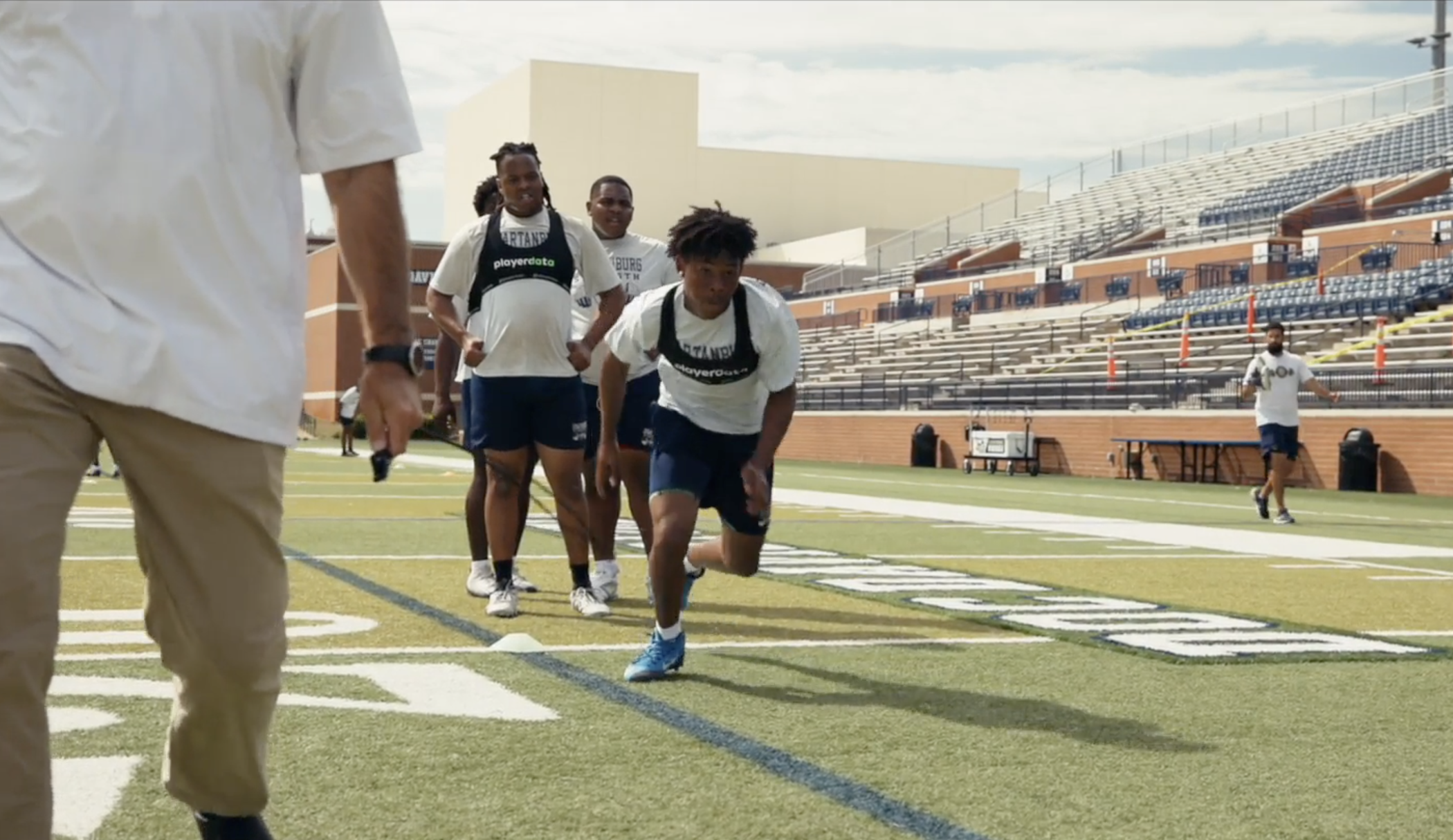
Spartanburg High School competes in Region 2-5A, which Coach Andrew Caldwell describes as one of the toughest football regions in South Carolina and maybe even the country. The Vikings often line up against schools with double the enrollment. They can't out-size the competition. So they've decided to out-develop them instead.
"Sometimes we might not be the biggest," Caldwell says. "But, we can be the fastest. We can be the strongest, and we can play with a lion's heart."
Caldwell has been the Director of Strength and Conditioning at Spartanburg for twelve years. He's responsible for every athlete in the program, starting at the middle school level. He brings a deeply analytical mindset to a job that most people underestimate. He came up through the weight room the old-fashioned way, spending time in the collegiate setting at East Tennessee State University and in the private sector before deciding he needed to be with a team. The goal he comes back to every day is straightforward: get every athlete to the gold standard. That's not a phrase he invented. It's the Spartanburg way.
He's Used the Competition. He Chose PlayerData.
Before PlayerData, Spartanburg ran a different GPS system, but it didn't work for the environment of their athletic department.
So, he switched. And the difference was immediate.
"PlayerData was just simpler to use and we could get the information quicker. The process of downloading the data wasn't long. We were able to upload it quicker, and it just took less time."
That matters more than it sounds. Caldwell isn't running a professional club with a full sports science department. He's a high school strength coach managing multiple sports, a network of assistant coaches, and a population of teenagers with a very short window of attention. The system has to work fast and the insights need to be accessible at a glance.
"There's a sweet spot with teenagers in terms of attention," he says. "We need to be able to provide the data and get their attention quick so they can get as much out of it. PlayerData is simple to look at, understand, and analyze quickly."
Before the Data
Even with his background, Caldwell will tell you that before GPS data he was operating on instinct.
"Before PlayerData, we were just simply guessing that our training was effective in terms of volume and speed."
That's a significant admission from someone with two decades of experience in the field. And it gets to something important: expertise and instinct will only take you so far without objective evidence to back them up. When you're trying to build buy-in from athletes, parents, and administrators, gut feel isn't always enough. Numbers are.
What Changed
PlayerData gave Caldwell the ability to quantify his work and then use that data to justify it.
"What PlayerData has given us is the ability to quantify what we're doing and then use that to prove that our training is effective in the weight room," he says. "We can use these performance metrics to show 'this is what we're doing in the weight room, and you can see how our speed is improving.'"
After every practice or training session, he goes back and reviews the data. How fast did each athlete run? How much volume did they accumulate? How does that correspond with what happened in the weight room? The detail the platform provides goes deeper than he expected.
"Maybe we're making more cuts to the right versus left," he says. "That can inform your coaching. Maybe we're training the right side of the body more than the left, which is going to cause asymmetries. We want kids to be balanced. That's information you wouldn't get otherwise."
The Two-Sided Value
The data does two things for Spartanburg's program. It creates buy-in and it protects athletes.
On the buy-in side, the numbers give his athletes something to chase. They want to play fast. When they can see their own speed data improving over time, training stops being something done to them and starts being something they're invested in.
"The data helps create buy-in from the kids because they want to play fast," Caldwell says. "They can see that they're getting faster over a course of time."
He also sees something beyond performance. In a school setting, GPS data connects athletes who might not naturally engage with math or science to something concrete and meaningful.
"This is helping you on the field. This math is helping you. This data's helping you," he says. "That goes beyond performance. It could connect a kid to something they didn't have a connection to before."
On the protection side, Spartanburg has a lot of multi-sport athletes who never truly get an off-season. GPS data helps Caldwell make smarter decisions about load and recovery, hold athletes accountable when the numbers show they're not working as hard as they can, and flag when a player's volume is trending too high before it becomes a problem.
"It's to keep them on the field," he says simply.
What It Means
Spartanburg isn't waiting for GPS data to become common at the high school level. They're already there. And for Caldwell, that's the point.
"Data is the future," he says. "And with PlayerData, we are ready for the future."
The gold standard at Spartanburg High School isn't just about winning football games. It's about developing athletes the right way, with the right information, and sending them into whatever comes next better prepared than when they arrived. Coach Caldwell has been doing this work for over twenty years. He's used other systems. He made a deliberate choice.
Now, he has the data to prove it was the right one.
Ready to see what PlayerData can do for your school?
Whether you're a public school, a private school, or a prep power house, we'd love to show you what's possible.
Submit your information below to book a demo. We're ready when you are.

.png)